Sport
The Joy and Sadness of Supporting Brazil
Thirty-six years, one country that was never mine, and a habit I can't seem to break.
July 2026
Sport
Thirty-six years, one country that was never mine, and a habit I can't seem to break.
July 2026
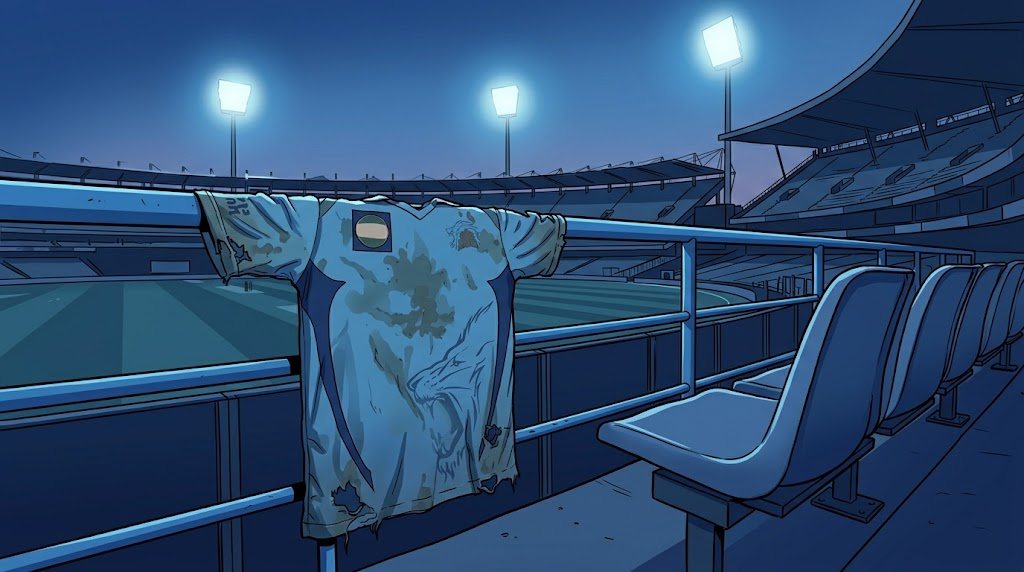
1990 was the first World Cup I remember watching, and I had never seen Brazil play a single match before it. What I had was my dad's stories about 1982: a team so good it apparently didn't need to win, and didn't. I took it as a nice piece of family folklore. I did not clock it as a warning label.
I already admired Maradona from replays of 1986, but Brazil was mine from the start, and once Careca began scoring goals that looked too clean to be real, it was settled. Then Brazil drew Argentina in the Round of 16. Maradona drifted forward from midfield, found Caniggia, who rounded the keeper and finished in the 81st minute. 1-0. I must have replayed that sequence a hundred times since, always arriving at the same useless thought: if Taffarel comes two steps further off his line, if the tackle five yards earlier actually holds, none of the rest of it happens. That was my first real disappointment as a sports fan, and the lesson wasn't about beauty. It was that the scoreboard doesn't care how you got there.
A few months later my family moved to England, Brazil slipped out of my head, and I became a Liverpool supporter instead. Brazil didn't stay gone for long. Liverpool drew Genoa in the UEFA Cup, and a Brazilian named Branco hit a free kick so good it's stuck with me longer than most of that season. By 1994 Branco was doing it again, a thirty-yard free kick to beat the Netherlands 3-2 in the quarterfinal, and Romário carried Brazil the rest of the way to the trophy. I hadn't actually planned for winning.
By 1998 we'd moved again, to Canada, and I'd spent two years watching Ronaldo. In one season at Barcelona he scored 47 goals in 49 games, including a solo run against Compostela that beat half the team, and he became the youngest Ballon d'Or winner ever. Watching him, it was easy to believe you weren't watching a promising player. You were watching the ceiling itself. My dad and I watched the 1998 final together in Toronto, full of an optimism 1990 should already have cured me of. Something had gone wrong with Ronaldo hours before kickoff. He was left off the team sheet, then mysteriously put back on it, and nobody watching knew whether it was him out there or a shaken version of him wearing his number. France won 3-0. A year or so later his knee gave out completely, and he spent close to three years rebuilding a body that had briefly belonged to the best player alive.
I've spent more hours than I'd like to admit imagining 1998 with the Compostela version of Ronaldo on the pitch. It changes nothing. It's also exactly what following this team does to you: you don't just lose, you get handed a full alternate history to run through your head afterward, for free, forever.
2002 gave me a win with no qualifiers attached. 2006 gave me a quarterfinal exit to a France team that simply played better. Since then it's been one disappointment after another, most recently this summer, when Norway knocked Brazil out in the Round of 16. Neymar scored a late penalty that changed nothing, then retired from the national team.
I already knew the routine. I watched Norway's second goal, Haaland from distance, more times than I'm willing to admit, not to relive it but to search for the version where it doesn't go in: a defender half a step closer, a body angled a few degrees differently, someone closing him down a beat sooner. That's the real ritual after a loss like this, more than the sadness itself. You reconstruct the ninety minutes frame by frame, hunting for the ten seconds where it could have tipped the other way, knowing it changes nothing and doing it anyway. It's a strange kind of grief, mourning a team that was never mine to grieve for. And it turns out to be a mild version of something much stranger back in my motherland.
It's tribal identity borrowing a jersey it has no real claim to, and it's proof that the ugliest thing about fandom was never losing.
Nowhere is football tribalism stranger, or sadder, than in Bangladesh, a country with no team in this tournament and no path to ever having one, where entire streets are strung with Brazilian and Argentine flags, some reportedly seventy feet long, block competing against block for whose colours own the skyline. There's real history behind it. Maradona's Hand of God against England read, in a country that had lived under empire, as something closer to a reckoning than a goal, and that part deserves respect. What doesn't is a twelve-year-old boy who was electrocuted in 2018 hanging a flag from a power line, for a team that isn't his country's, in a rivalry that was never his to inherit. That's the part I can't get past. None of it is actually about Brazil or Argentina. It's tribal identity borrowing a jersey it has no real claim to, and it's proof that the ugliest thing about fandom was never losing. It's mistaking a team you support for a country you belong to.
I understand the love completely. I've just never needed the ownership that seems to come bundled with it. I still miss the glory days, even the ones I only know through my dad's telling. I still enjoy watching Messi without any sense of contradiction, and I've never had to dislike Argentina to justify supporting Brazil, a stance that seems to genuinely confuse fans who treat this rivalry as a matter of national loyalty. I have none here. I'm not Brazilian, and I have no allegiance beyond memory.
But decades in, I still find myself hoping the samba style comes back one day, not because I need Brazil to win again, but because I'd like to see that kind of football while I can still appreciate it. That's the whole point of watching without a flag: no blood in the game, just the hope that somebody, anybody, plays something beautiful before the final whistle.
No spam, no algorithm deciding when. Just the next one, whenever it's actually ready.
Opens Buttondown in a new tab to confirm your subscription. Powered by Buttondown.