Sport
How Waqar Younis Defined My Childhood
For a South Asian kid in 90s England, one fast bowler turned a slow game into a religion.
February 2026
Sport
For a South Asian kid in 90s England, one fast bowler turned a slow game into a religion.
February 2026
To the historians and the experts, the debate is usually settled by the stats. They point to the relentless consistency of Glenn McGrath, the complete artistry of Wasim Akram, or the menacing intellect of Malcolm Marshall. And if we are speaking strictly with our heads, they are probably right.
But I don't measure greatness by the record books. I measure it by the feeling in my chest. And for a young kid growing up in England in the early 1990s, there was no debate. There was only Waqar.
I didn't grow up obsessed with the gentleman's game. To a child, Test cricket can feel like an eternity of defensive prods and rain delays. I didn't fall in love with cricket first. I fell in love with Waqar Younis. He was the gateway drug. He took a game of chess and turned it into a demolition derby.
My obsession began with a gift from my father in 1989.
Back then, live global sport wasn't the norm on television. You had to hunt for footage. One day my dad came home with a fuzzy VHS tape of a match in Sharjah. Australia were playing, and Dean Jones was at the crease. At that time Jones was perhaps the best one-day batsman in the world: arrogant, brilliant, at the absolute top of his game.
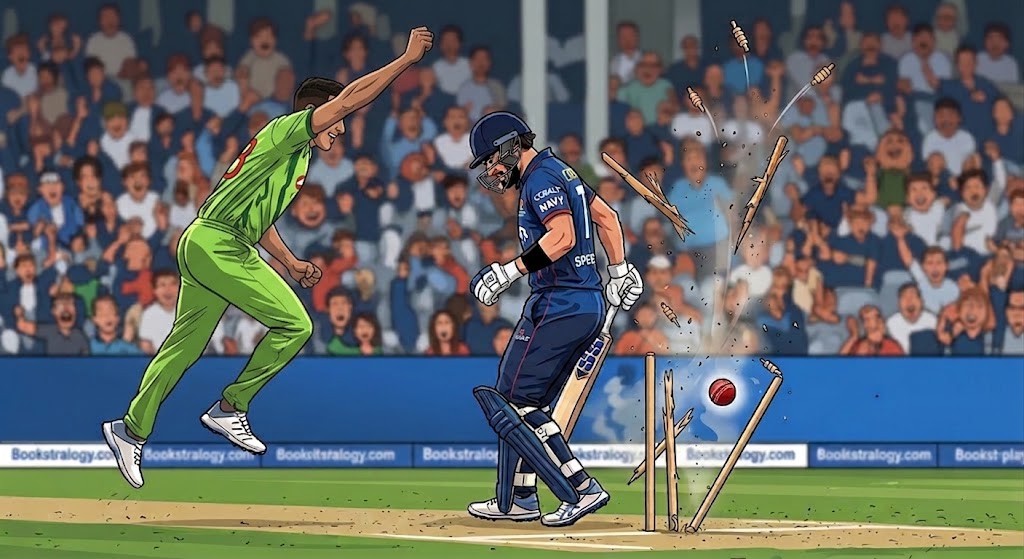
My dad called me out of my room and said there was something I needed to see. It was a teenage Waqar running in and unleashing a delivery that was past Jones's bat before he could blink. The stumps went flying.
That was it. The next day, I took the tape for myself.
I sat there alone and hit rewind twenty times in a row to watch that thirty-second clip. Rewind, play. Rewind, play. My dad had provided the spark, but the fire was mine after that.
Once I was hooked, I followed him everywhere. In 1991 he played for Surrey, and it remains, in my opinion, the most destructive season any overseas fast bowler has had in county cricket: 113 wickets at 14.65.
To put that in context, a good professional bowler averages somewhere between 25 and 30, and even the all-time greats usually sit in the low 20s. Waqar wasn't just taking wickets. He was taking them so cheaply and so often that batting line-ups barely had time to settle. The Oval was traditionally a graveyard for fast bowlers, flat and slow. Waqar took the pitch out of the equation entirely.
Rewind, play. Rewind, play. The fire was mine after that.
He never really stopped, either. Six years later, playing for Glamorgan, he was still at it: 7 for 25 with a hat-trick against Lancashire, 8 for 17 against Sussex.
It wasn't only cricket fans who noticed. Years later, Usain Bolt said his childhood hero was Waqar. Growing up in Jamaica, the land of Holding and Walsh, Bolt supported Pakistan because of that run-up and those swinging yorkers. The fastest man who ever lived grew up wanting to be a fast bowler, and the one he picked was mine.
Then came 1992, the summer that produced the best cricket I've ever watched. It came with a twist. Months earlier, a stress fracture in his back had kept Waqar out of the World Cup, which Pakistan won without him. Nobody knew what kind of bowler would turn up in England.
It was also the summer my dad understood exactly where I needed to be. On the morning of the Lord's Test, he was supposed to take me to school. Knowing the game would start in a couple of hours, he made an executive decision. "You just want to stay home today and watch?" he asked.
I didn't even have to answer. We stayed home, and we watched history.
England were cruising. Graham Gooch and Alec Stewart put on a big opening stand, and at 197 for 3 it looked like a long, flat day of English batting. Then Waqar happened. With the old ball he found that late, lethal swing, and the innings fell apart. England were all out for 255.
I vividly remember sitting there with my dad, cheering as the stumps cartwheeled out of the ground. My mom might have been annoyed about the missed school day, but when Waqar raised the ball for his five-wicket haul, my dad and I knew it had been worth it. Pakistan went on to win that Test by two wickets. That wasn't normal cricket. That was destruction.
He was still a terror in New Zealand in 1994. By then every batsman knew what was coming, and they still couldn't stop it. It wasn't just that he was fast. It was that he was inevitable.
But the price of that action kept coming due. The back that had already broken once never let him be quite that bowler again. He came back from every injury, he stayed world class, and he went on to captain his country, but the force of nature from those first few years was gone.
Perhaps the greatest gift, and the greatest curse, Waqar gave me was the belief that anything was possible. With Waqar, the scoreboard didn't matter. You could be defending 200 with the opposition cruising at 180 for 2. With any other bowler, the game is over and you turn off the TV.
But with Waqar and the old ball, you still believed. In the space of twelve balls he could rip the heart out of a batting order and win the match.
In hindsight, it was unfair what he did to me as a child. He rewired my brain to believe a game is never lost. I've spent the decades since supporting teams that didn't have Waqar Younis in them, watching the opposition cruise to victory and thinking, "We can still win this." The belief stayed. The wickets didn't come. He set a standard of hope that no one else could live up to.
I accept that others had better careers on paper. Glenn McGrath was a metronome: he bored batsmen out. Wasim Akram was a genius: he tricked them out.
Waqar Younis scared them out.
And for a South Asian kid growing up in England in the early 90s, he was something bigger. It was a time when the environment wasn't always welcoming, racism was something we lived with, and feeling othered was the norm. Then I saw Waqar: swagger, aggression, undeniable dominance. He taught me I didn't have to be white to be cool. He was the hero who looked like me.
Today, when I see kids online obsessing over Jasprit Bumrah's yorkers, I can only smile. Bumrah will probably finish his career rated higher than Waqar, and he deserves every bit of it. But that Waqar run-up, the rhythmic sprint from the sightscreen with the whole crowd clapping in time to every step? That particular theatre will never be matched. There's a reason he still holds the record for the most five-wicket hauls in one-day internationals.
For the boy rewinding a VHS tape in 1989, for the son allowed to skip school to watch a miracle at Lord's with his dad, and for a kid in Jamaica who would grow up to be Usain Bolt, Waqar Younis was the most thrilling sight in the sport.
There will be others. For me, there will only ever be Waqar, and cricket has never quite looked the same since.
No spam, no algorithm deciding when. Just the next one, whenever it's actually ready.
Opens Buttondown in a new tab to confirm your subscription. Powered by Buttondown.