Life
Waiting to Be Noticed
More than a decade at the same level, and two theories about why: something is wrong with the place, or something is wrong with me. The honest answer turned out to be both.
October 2026
Life
More than a decade at the same level, and two theories about why: something is wrong with the place, or something is wrong with me. The honest answer turned out to be both.
October 2026
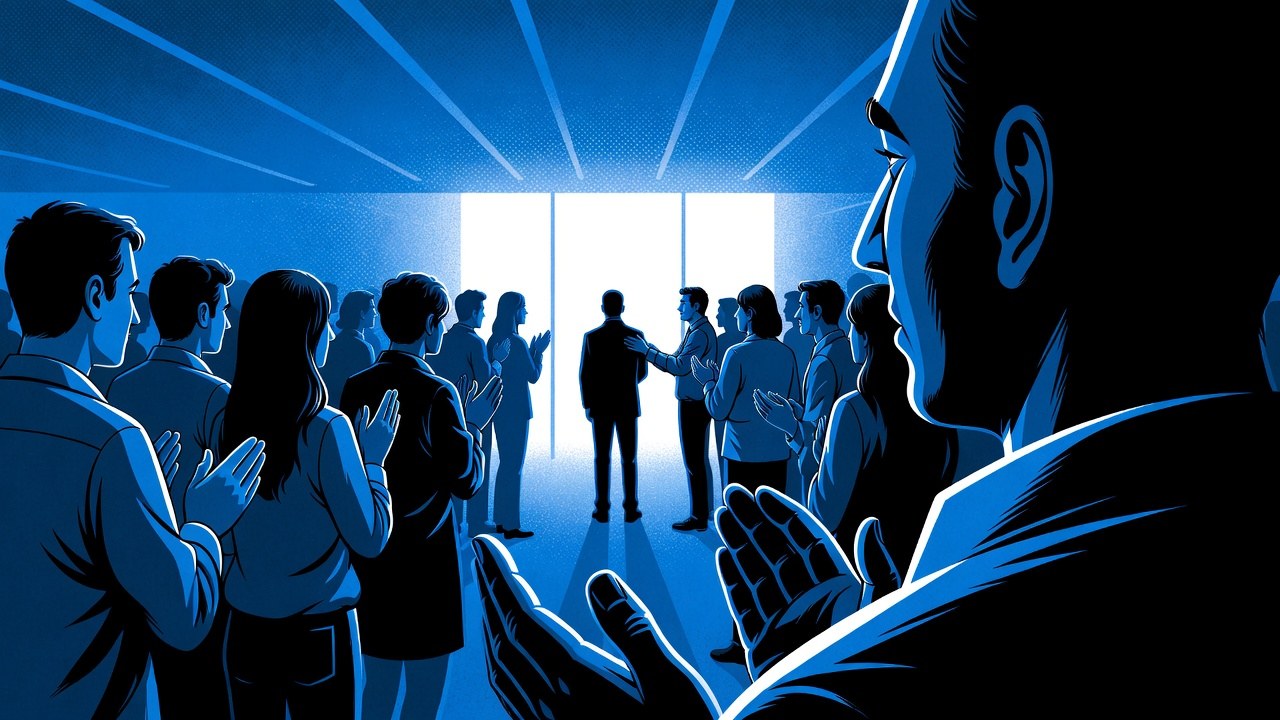
Here is what I believe right now, this week, with some heat behind it: where I work, the people who rise are the ones willing to be cruel.
I have a specific person in mind. I won't describe the job, because the job doesn't matter. What matters is the method. Their team works weekends, often on nothing important. Someone gives up a Saturday on work nobody needed, because their manager forgot a deadline, or because delivering early would sound good upstairs on Monday. When the work goes well, it arrives upstairs with one name on it. When it goes badly, the name on it changes. And every few months there is a fire that, if you trace it back carefully enough, they lit, followed by a meeting where they put it out and everyone thanks them.
They were promoted. I clapped, because that is what you do.
So that's my position. Dark traits get promoted. I don't want to be someone who uses them. Maybe that means I don't have what it takes, and maybe that's fine, because I'd rather be true to myself.
It's a good position. It flatters me from every angle. If I don't move up, it's proof of my decency. If someone like that moves up, it's proof of the system. I can't lose. That's what makes me suspicious of it.
This week gave me another reason. A project of mine slipped, and the delay wasn't all my fault. I caught myself doing the thing I thought I'd stopped doing: quietly taking the blame, and putting off telling senior management. By the time I raised it, my boss thought I'd been withholding information, and told me so. It was an uncomfortable conversation. I explained clearly what had happened, apologised for waiting, and she understood what I'd been trying to do. The problem is still mine to solve. I just didn't cause it, and this time I said so. The discomfort lasted one conversation. Staying quiet any longer could have turned it into something much bigger.
It made me ask what I've actually been true to. I have fired people who worked for me, people who weren't doing the job. It took me far longer to get there than it should have, and I know why. For years I believed my team loved working for me, and that because they loved it, the work would get done. I wanted to be the cool manager.
When I told my therapist I felt bad about firing one of them, the answer I got was that it isn't empathy. It's a lack of courage.
I didn't argue. I knew it was true the moment I heard it. I'd been using empathy as a shield.
The need to be liked was driving all of it. The person who got promoted needs to be admired. I needed to be liked. I had been telling myself those were opposites.
There's also a fact my position has to step around. I used to be the one getting picked. I was made a director in my thirties. That was more than a decade ago. I've changed jobs and teams since, and I'm still at the same level.
So I can't say this place only promotes cruelty. It promoted me. Whatever it saw back then, either I had it and lost it, or I still have it and something else is in the way.
I earned every promotion I've had the same plain way. I worked hard and someone noticed. I didn't have goals. I'd convinced myself that if I did the work, everything else would follow, and for a while it did.
Then my first marriage began to end, and I think my drive went with it. I wasn't getting validation at home, so I went looking for it at work, in being liked rather than in the work itself. That's where the cool manager came from, though at the time I thought of it as a different kind of leadership, a path of my own. I did the bare minimum. The divorce, when it came, was also a new beginning: a new role in a new department, and I thought I was doing everything right. But my old habits had come with me: no urgency, not chasing people when work slipped, and a general complacency I'd dressed up as being nice.
Some of that niceness had been learned the hard way. Early in my career I was quick to fire. Then I put an underperforming employee on a performance plan, and they filed a complaint with HR against me. There was an investigation, and it ruled in my favour. But the whole thing shook me, and I went soft. Some of my edge didn't come back.
Then a project failed and the blame landed on me. People around me kept telling me it wasn't fair. I was working harder in those months than I had in years. But I've come to think it was retribution for something else, those habits catching up with me. The hard work arrived too late to count.
The work was real, then and since. But "do the work and everything else will follow" was only half a plan. The other half was wanting something out loud, and without it, the work turns into waiting to be noticed.
I didn't come up with that belief on my own. I grew up in a Bangladeshi family where humility wasn't one virtue among many but the first one you learned. You didn't talk about what you'd done. You let others notice, and if they didn't, that was fine, because the work would speak for itself.
My elders had a saying for it: Nije jare boro bole, boro shei noi. Loke jare boro bole, boro shei hoi. The one who calls himself great is not great. The one others call great, is.
I still find it nearly impossible to promote myself, and I built a line to hide behind: I am more than what I do for a living, and too cool to boast about myself. So when I reached rooms that rewarded people who could narrate their own wins, I stayed quiet and called it character. Some of it was. Some of it was a lesson I'd never thought to question, in rooms full of people who had never been taught it.
Needing to be liked. Lacking courage. Being raised humble. I've been treating them as three explanations. They might be one habit: stay quiet, and let other people decide what my work is worth.
The research half agrees with where I started.
In 2015 a group of organisational psychologists led by Emily Grijalva pooled dozens of studies on narcissism and leadership. They separated two questions that usually get blurred: who gets picked to lead, and who turns out to be good at it. Narcissists reliably win the first. On the second, how effective they are once they're there, the overall relationship was close to zero.
But it found two more things I've been less eager to sit with.
The first is why narcissists emerge. Mostly it comes down to extraversion: they speak first, they speak with certainty, they take up room. That isn't a dark trait. It's a loud one. Some of what I've been calling cruelty in other people might just be volume, and some of what I've been calling decency in myself might just be quiet.
The second is the shape of the curve. Effectiveness didn't track narcissism in a straight line. It rose and then fell. Too much and you get the person who got promoted. But too little also produced ineffective leaders, people without the self-belief to make a call and carry it. The best place to be was the middle.
I had assumed I was standing on the right side of this argument. The study suggests I might be standing on the other end of the same problem.
Which brings me back to that failed project, because there's another version of it I tell more often.
In that version, I wasn't blamed. I took it. The work was my team's, someone had to wear the failure, and I wore it. I didn't push it down onto them and I didn't push it sideways onto anyone else. It cost me my year-end bonus.
For a long time that was my favourite story about myself. It was the opposite of the person who gets promoted. They throw people under the bus; I stood in front of it.
So I have two versions of the same few months. In one, the blame was unfair and it landed on me. In the other, I chose to carry it. In neither of them do I say anything.
There's a reason for that silence I'm less willing to give up. I was raised to believe you can't control other people's behaviour, only your own. So when something fails, I don't look for who to blame. I look for what I could have done differently. Years later I found Stoicism, which says much the same thing, and a habit became a philosophy.
I still believe it. But it has costs I didn't see. In a room where the first question after a failure is whose fault it is, the person asking what he could have done differently is volunteering an answer. And because I don't get loud, senior people have sometimes read my calm as not caring.
The harder conversation would have been with the people above me: this went wrong, here is why, here is what was outside our control, here is what I'd change. That would have meant arguing. Taking the hit quietly meant I didn't have to. I am, by nature, someone who avoids confrontation, and I had found a way to make avoiding it look like loyalty.
It's possible to do the right thing for the wrong reason. The loyalty was real. So was the relief.
The obvious answer to all of this is that good people do rise. And they do. I've worked under a few VPs who led with honour and with empathy, who knew their people's names and what was going on at home, who took the hit without needing a speech about it.
Every one of them got to VP. That is the step I've been standing in front of for more than a decade. They got there without being cruel, so "you have to be cruel to rise" isn't true. It's the thing I'd like to be true, because it would explain my own ceiling without asking anything of me.
What happened to them afterwards is harder. Some were pushed out. Some left on their own. Good people can get in. It's staying that seems to cost them something.
So the honest version of my position is smaller than the one I started with. It isn't that dark traits get promoted. It's that loud traits get noticed, cruel traits sometimes survive, and decent people can rise but have to decide, every year, whether the place is worth what it takes out of them.
Even "cruel" is too strong for most of it. Most of what I've been calling cruelty is self-preservation: people covering themselves because they're scared for their jobs. That isn't admirable, but it's ordinary. I called it cruelty because cruelty made a better excuse for my complacency than ordinary did.
So do I even want the next step? Some weeks, no. I look at the next level and see longer days, more meetings, the same politics with higher stakes, and I think I'm fine where I am.
Then I sit in a room and watch something get decided badly by someone who shouldn't be deciding it, and I want it so much it surprises me.
Some of that feeling is genuinely wanting things to be run well, wanting the people under me to have the boss I wish they had. But some of it is wanting to be proven right. Wanting the person who got promoted to look up one day and find me above them. That isn't a leadership instinct. That's a grudge with a job description.
When I try to work out what happiness is, I don't get a definition. I get a list.
My wedding, two years ago.
Weekends with my nephew.
Time with my wife, doing nothing in particular.
Nothing on that list happened at work. Most of it happens on weekends.
The person I've been angry at all week spends other people's Saturdays on work that doesn't matter. It's the thing I'd never do. And yet the version of me that wants their job, that wants it badly enough to change how I behave in rooms, would have to be willing to give up my own.
The question was never whether I have the dark traits. Some of them, probably; the grudge is evidence enough. I don't need more of them, and I'm not going to become someone who covers himself first and looks for a name to put on the problem. The question is the one my therapist put to me. Whether I have the courage to find the middle of the curve: not to change what I believe about failure, but to stop absorbing and start arguing upward.
Maybe that courage gets me the next step here. Maybe it doesn't. I enjoy my weekends too much, and promotion was only ever what came next. Self-preservation will be wherever I go; scared people are scared everywhere. Some places reward it more than others, and I'd rather work in one where a failed project is a problem to solve rather than a person to find. But leaving won't do the work for me. Wherever I end up, I'll still have to say out loud what I think went wrong, and want something in a room instead of waiting to be noticed.
I'd like it to be a decision, made with my eyes open on a Saturday, with my nephew asking me something and my wife in the next room. Not a story I tell myself on a Monday about why I was too good for it.
No spam, no algorithm deciding when. Just the next one, whenever it's actually ready.
Opens Buttondown in a new tab to confirm your subscription. Powered by Buttondown.