Culture & Cinema
Please Don't Call Me Abu Bakr
My wife says I'm her Abu Bakr. She means it as the highest compliment. I'm taking it as an insult.
Culture & Cinema
My wife says I'm her Abu Bakr. She means it as the highest compliment. I'm taking it as an insult.
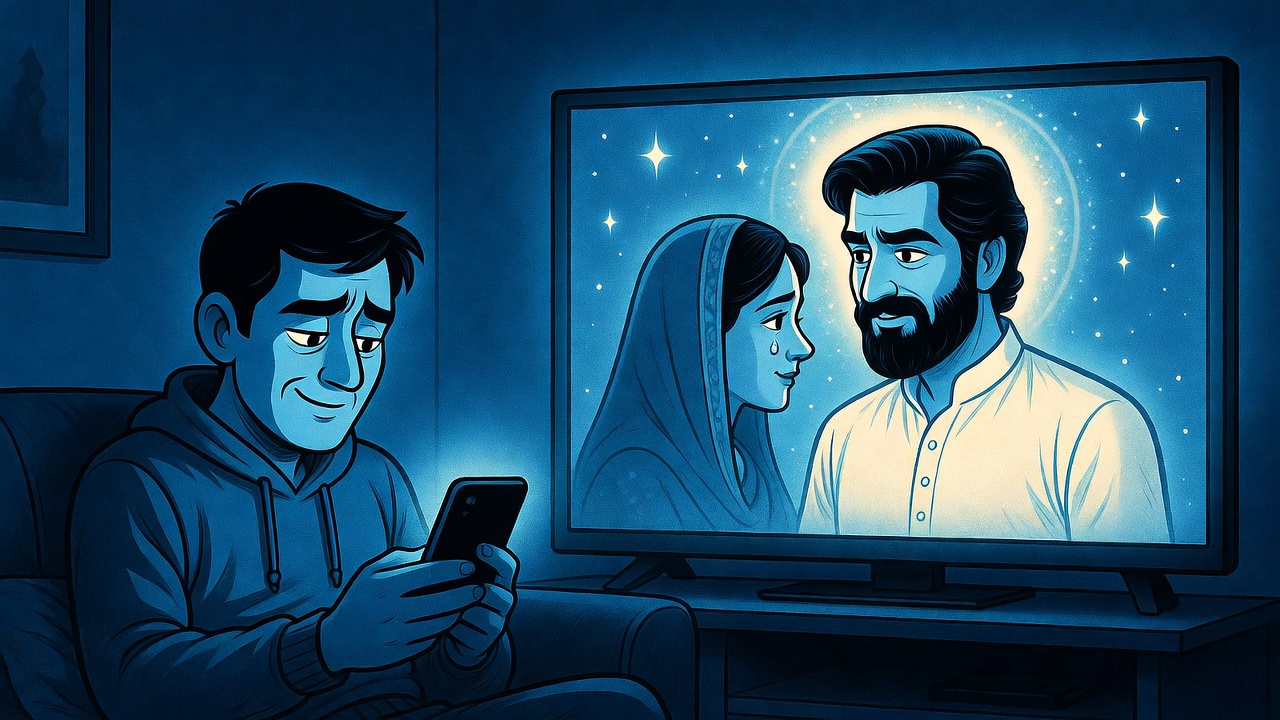
It was a Sunday afternoon, and I was doing my favourite Sunday afternoon activity, which is nothing, when my phone buzzed. A text from my wife. First, a meme.
"When you lose everything, yet Allah blesses you with what you never even asked for.....this is the reward for your patience. A life partner like Abu Bakr."
Then a second text: I am lucky to have you.
So there it was. She wasn't wishing for Abu Bakr. She was telling me I was him. I was also, apparently, the reward for enduring total loss, but it seemed like the wrong moment to ask what she'd lost.
Most husbands dread being compared to another man. I win the comparison and still want out, because Abu Bakr isn't a man. He's a fantasy with a soundtrack.
For anyone who has escaped it so far, Dar-e-Nijaat is the latest Pakistani drama, readily available on YouTube, and Abu Bakr is its hero: a voice that never rises above a murmur, and the posture of someone who has never once lost his car keys. When the heroine, Zaryab, falls apart under panic attacks after a heartbreak, he arrives with the right words, the right silence, and, I assume, perfect wudu.
I should declare my bias. I can't stand this show, or any of them. Pakistani drama, as a genre, is brain rot with better lighting. Every show is the same show: a saintly heroine, a mother-in-law with a grudge, a cousin with a secret, a girl sobbing "but I don't want to marry my cousin," and forty episodes of people staring out of windows while a sad song explains their feelings to them. Dar-e-Nijaat just adds a sermon. Some nights I escape. Other nights I'm in the room, and leaving would start a conversation. Either way, you don't need to watch every episode to know what's happening. You could miss a month and not miss a thing.
I know how this sounds. My wife sends me something sweet, and I reply with a thousand words of complaint. In my defence, I have three problems with the title.
The first problem is the rescue. Abu Bakr exists to save someone. Zaryab is hurting, and the show's answer to her pain is a man. Not therapy, not friends, not her own slow work of getting better. One viewer put it perfectly: she loved the show, but hoped the writer hadn't shown that a man will save you. It's a terrible instruction manual, because it teaches women that healing arrives with the right husband instead of being something they're allowed to do themselves. I don't want to be anyone's cure. When my wife is upset, I don't arrive with the right words and the right silence. I arrive with a question: "What should I order for you on Uber Eats?" It is never the right question. I'd rather sit next to her while she handles it.
The second problem is the standard. Abu Bakr is never tired, never short-tempered after a bad day, never scrolling his phone during an important conversation, never asleep on the couch at nine thirty. Nobody can live up to that, and I'd rather not be measured against a man who has a scriptwriter.
The third problem is the one that actually bothers me. The show turns piety into romance. The soft-spoken faith, the prayer mat, the gentle sermons: all presented as proof of a man who will treat you well. But anyone who grew up in a South Asian family knows that religiosity and kindness are separate qualities. Teach young women that the outward signs of faith are the same as goodness, and you've handed them a checklist the wrong man can easily fake. Piety is a lot easier to perform than patience. I know men who pray five times a day and still can't find the dishwasher.
Piety is a lot easier to perform than patience.
The show's own contrast makes it worse. Zamil, Zaryab's first love, is a born-again Muslim, and he still betrays her and marries someone else. He's the heartbreak behind those panic attacks, and he exists as a foil, as if one bad religious man proves the other one righteous. It's a line-up with only two suspects, the villain and the saint, and the ordinary man who is neither doesn't even get cast.
So no, I don't want the title. I'm a regular man with a regular temper, an unreasonable attachment to 80s synth, and a habit of explaining things nobody asked about. Abu Bakr has never explained, over dinner, how a bank can lend out money it doesn't actually have. I have. More than once.
To be fair to her, she isn't entirely wrong.
When she sends me that meme, she isn't talking about the prayer mat or the rescue or the speeches. She means something smaller and more real. That I listen. That when things get hard, I stay. Strip away the background music and the slow-motion close-ups, and that's all Abu Bakr really is: a man who pays attention. Millions of viewers aren't sighing at their screens because the drama invented something impossible. They're sighing because a man who pays full attention has become rare enough to look like fiction.
I still haven't replied to that Sunday text. I've typed I'm lucky to have you too half a dozen times and deleted it, because it sounded exactly like something Abu Bakr would say. So I'm sending this instead. All thousand words of it.
I'm lucky to have you too. Please stop calling me Abu Bakr.
No spam, no algorithm deciding when. Just the next one, whenever it's actually ready.
Opens Buttondown in a new tab to confirm your subscription. Powered by Buttondown.