Screen & Sound
Proud, Not Laughing
A Bangladeshi comedian made it to Netflix. I was proud. I didn't laugh. Then I started to wonder whose fault that was.
October 2026
Screen & Sound
A Bangladeshi comedian made it to Netflix. I was proud. I didn't laugh. Then I started to wonder whose fault that was.
October 2026
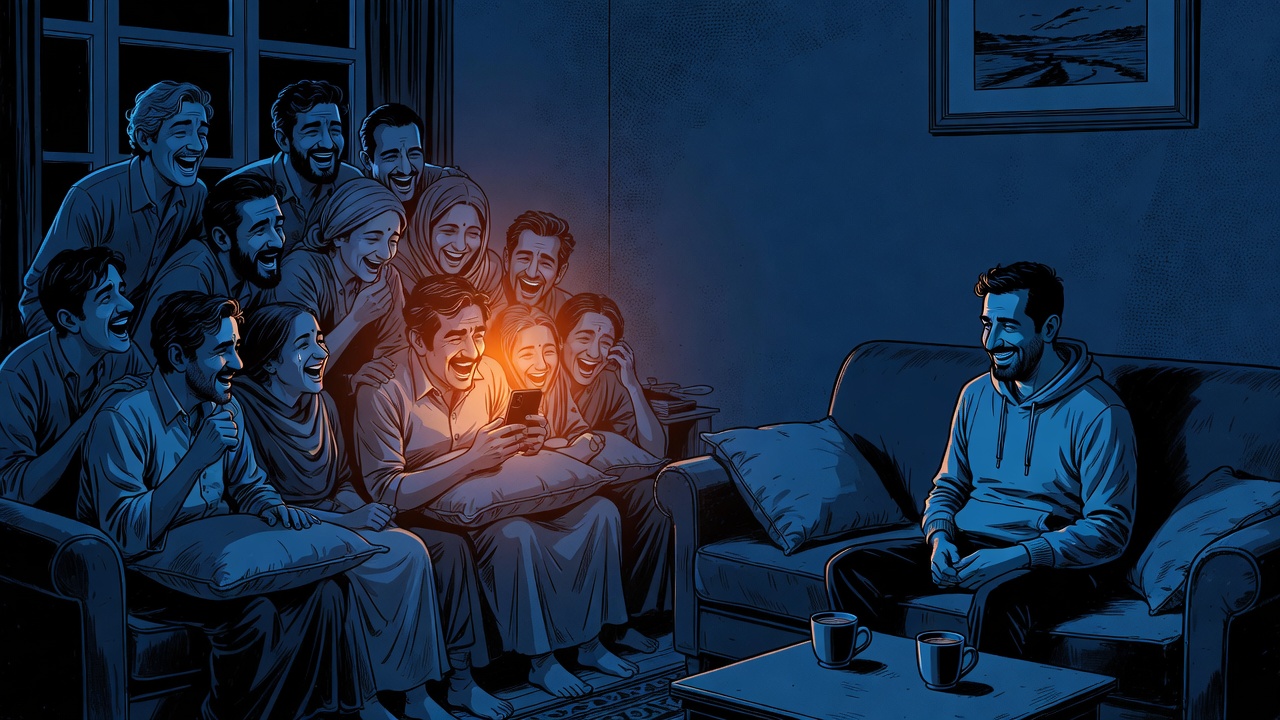
There is a specific kind of joy that comes from seeing a Bangladeshi name somewhere it isn't supposed to be. A byline in a major newspaper. A credit at the end of a Hollywood film. A comedy show on Netflix with Kevin Hart's name on it. It comes with a sense of hope and expectation, and one quiet question: is this finally about to happen?
I met Usama Siddiquee the way most people meet anyone now: in reels, somewhere between a cooking video and someone's holiday. The clips put me off. I scrolled past, and that would have been the end of it.
Then this year he finished runner-up on Funny AF with Kevin Hart. A Bangladeshi comic in the final of a Netflix comedy competition is not a small thing, and I didn't want to write him off on the strength of a few clips. So I did the fair thing. I sat down, watched the show, and gave him a proper chance.
I waited to laugh, and I am still waiting.
It didn't help that a lot of my friends and family went to see him live. They came back and couldn't stop talking about how funny he was. All I could do was grin and nod. The grin was real. The nod was doing a lot of work.
By the standards of his profession, Siddiquee has done almost everything right. He has done Colbert, he passed at the Comedy Cellar, and this year he signed with one of the biggest agencies in the business. He grew up Bangladeshi in North America, with parents who had plans for him, which means that on paper I am his ideal audience. I am Bangladeshi. I have lived in North America most of my life. I also have parents.
And his parents, the story goes, wanted him to be a doctor.
That is roughly where he loses me.
The problem isn't that the jokes are untrue. The guilt trips, the disappointed father, the mother keeping score of other people's children, the aunties with opinions on everything: I know these people. The problem is that the jokes are true the way a horoscope is true, broad enough to fit everyone and specific to no one. When a brown comic tells a room that his parents wanted him to be a doctor, the room laughs because it recognizes the shape of the joke, not because anything surprising has happened. I have heard some version of that bit from nearly every South Asian comic who has picked up a microphone since the late nineties. It isn't a punchline anymore. It's a genre.
Take the bit I've seen him do about immigrant parents. Greek, Haitian, Bengali: it turns out they're all the same, all obsessed with school and respect. It's built to land with everyone, because everyone has one of those parents. I don't doubt it's true. I just don't hear anything in it I couldn't have guessed from the word "immigrant." A sentence into a setup like that, I already know where it's going, and some part of me has quietly left the room.
The other half of it is harder to put into words. Stand-up is mostly persona. Siddiquee carries himself with an air of smugness. It's there in the smirk after a line, and in the long pause that follows, the one where he waits for the laugh to arrive. Sometimes, before it comes, he fills the silence with his own. Plenty of great comics are confident, and they earn it: the confidence arrives after the laugh. With him it arrives before. Some people find that infectious. To me it feels like being told a joke is funny before I've had the chance to decide.
I've always gravitated to comics who seem mildly irritated that they have to explain anything to you at all. Which brings me, a little awkwardly, to the other Bangladeshi comedian in my life.
Aamer Rahman has Bangladeshi parents too, and came up in Australia as half of the duo Fear of a Brown Planet. When I watched his "Reverse Racism" bit, I was blown away. It sounded like words that had been sitting in my brain for years, finally put in order and delivered with perfect humour. He explains why the idea doesn't exist by laying out, with great patience, the centuries-long time-travel scheme it would actually take to pull it off. It is calm, it is furious, and it is very, very funny. I didn't learn anything new from it. I just finally heard it said properly, by one of us. I was laughing and I was proud, both at once.
I have been looking for a Bangladeshi comedian all my life. For years I waited for one of us to get properly famous, and Aamer Rahman was my hope. That clip is more than a decade old now. He had the tours and the material, but he never crossed over the way I wanted him to. When a Bangladeshi comedian finally did, it was someone else, telling a very different kind of joke.
The difference is depth, and direction. Siddiquee dances around the big topics, touching each one and moving on before it can get uncomfortable. Rahman walks straight into them and stays until the room gets it. Siddiquee explains his parents to the room. Rahman explains the room to itself.
That should be the end of it. A matter of taste, and taste is allowed to be unfair. But one thing kept nagging at me. I don't sit through an entire Netflix competition for a comic I find unfunny. I do it for a brown one. With Siddiquee I wasn't just watching a comedian. I was looking for someone to relate to, someone who would do for my life what Rahman did for that one idea: take the words already sitting in my head and finally say them out loud. When he didn't, I wasn't merely unamused. I was let down.
And that, it turns out, is his material.
The parents in his act didn't want just any son. They wanted a specific one, the one they had already pictured, with the stethoscope and the respectable job. And here I am, watching a Bangladeshi kid come second on Netflix out of a field of hungry comics, and my first reaction is: but why aren't you Aamer Rahman? I didn't want him to be a doctor. I wanted him to be a different comedian.
Maybe that is what high brown standards really are. Not cruelty, just too much hope packed onto too few people. When only a handful of us make it to the big stages, each one is quietly asked to carry everything: be funny, be true, be ours. That is an unfair load to put on one man with a microphone. His parents put it on him once. Now, apparently, I'm doing it too.
None of this makes him funnier to me. His style just isn't mine, and that isn't his fault. The heavy expectation is mine. But it changes what I think I'm owed. When he books the next big spot, and he will, I'll feel that same sense of hope and be glad his name is on the poster.
Because somewhere a kid in Dhaka or Scarborough is going to see that poster and decide stand-up is a job people like us are allowed to have. Maybe that kid grows up to be the one who finally says the thing about my life I never managed to say. If that happens, it will be partly because Usama Siddiquee got there first and held the door open. I'll be in the front row for that one, laughing.
For a long time, having one of us on a big stage felt like the whole victory. You took what you got, and you were grateful. The real victory is quieter. Representation was never supposed to mean I'd like everyone. It means I can stop asking each one to be everything, because he isn't the last. He's the reason there will be more.
Proud, yes. Laughing, not yet. Waiting, the way only family can.
If you've never seen it: Aamer Rahman, “Reverse Racism”
No spam, no algorithm deciding when. Just the next one, whenever it's actually ready.
Opens Buttondown in a new tab to confirm your subscription. Powered by Buttondown.