Worldview
The Bideshi Premium
A Canadian moves to Dhaka, discovers it has buildings, and collects 1.4 million likes. I'm Canadian too. Nobody lines up for my chicken fingers.
Worldview
A Canadian moves to Dhaka, discovers it has buildings, and collects 1.4 million likes. I'm Canadian too. Nobody lines up for my chicken fingers.
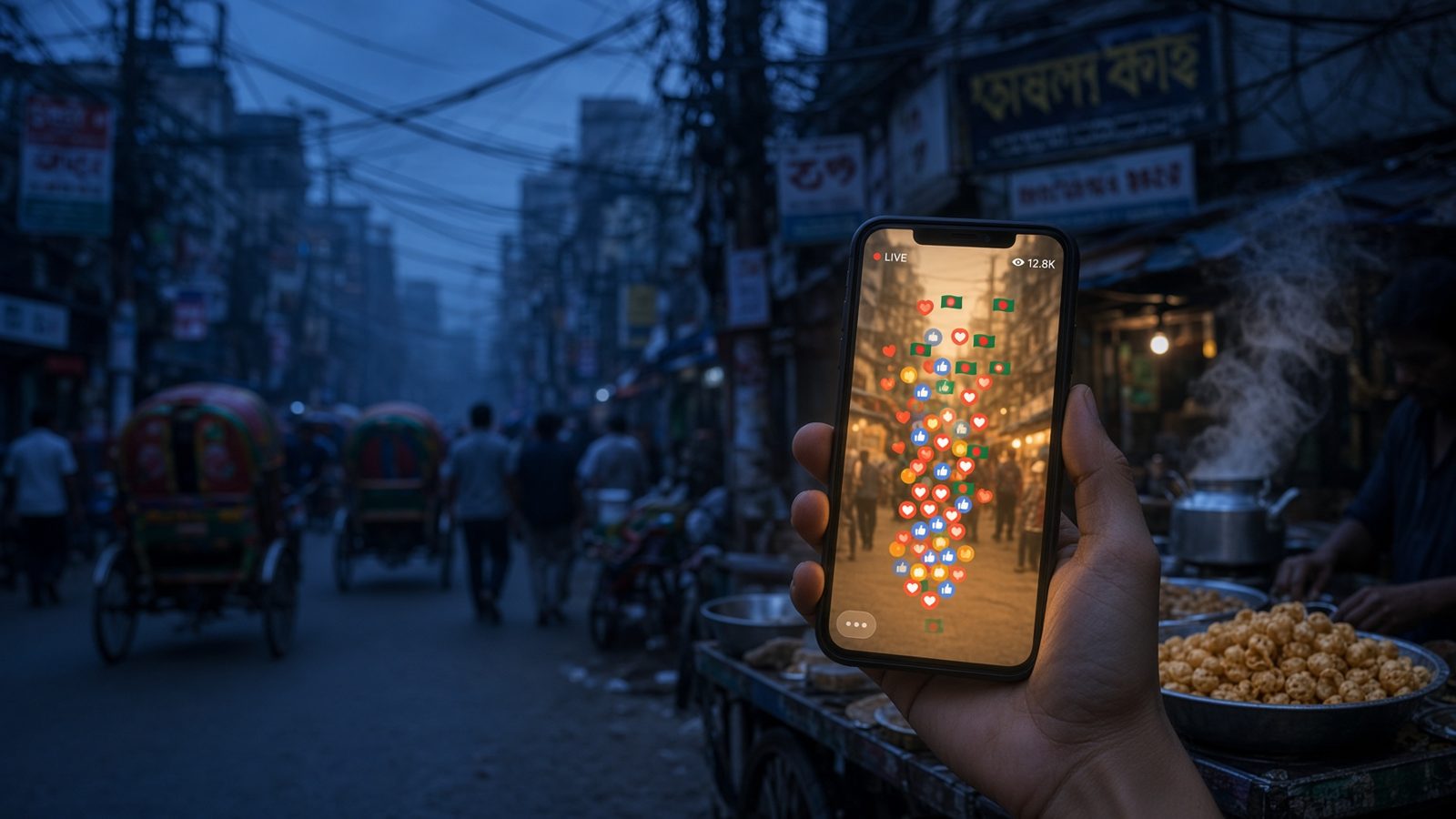
It's late on a weeknight in Toronto and my thumb stops on a familiar sight: a bald white man in Dhaka, grinning over a plate of fuchka like he has just split the atom. The caption says he loves Bangladesh. The comments go the way they always go. Bhai, you are more Bangladeshi than us. Heart, heart, flag, heart. I've seen this one live. It played out at my own wedding, but more on that later.
His name is Alex Kreissl, a Canadian vlogger who has made Bangladesh his home and his brand. As I write this, his Facebook page has passed 1.4 million likes, and his TikTok sits just shy of 100,000 followers and 3 million likes. His video titles read like postcards from a man who expected much less: Modern Bangladesh Surprised Me. Canadian Foreigner Loves Bangladesh. I'm Never Leaving Bangladesh. The central plot twist of the genre is that a country of 170 million people turns out to have roads, restaurants, and Ramadan.
I've studied the formula and I believe anyone can follow it. Step one: be white. Step two: stand near something Bangladeshi. A rickshaw works. A tea stall is better. Step three: be white. Step four: be white. Step five: look delighted, although honestly this one is optional if you've nailed steps one, three, and four. The algorithm takes it from there.
To be fair to the man, I don't think he's a villain. He seems to genuinely like the place, and liking Bangladesh is not a crime. It's actually a very reasonable position. But liking biryani is not a talent. Millions of people do it every day without a sponsorship email in their bio. The question isn't whether Alex enjoys Dhaka. It's why Dhaka enjoys watching Alex enjoy Dhaka quite this much.
And that's where the joke stops being about him.
We did this. Not Alex. Us. The lesson travels well, too. I live in Canada, a country where people pay good money to get a tan, and my mother still warns me not to play too much golf because I'll get dark. Eighteen holes in beautiful Ontario countryside, and her concern isn't my swing or my knees. It's my complexion.
We had two centuries of being told that a white face meant authority, and we absorbed the lesson so well we now hand it out for free. Scroll past Alex and you'll find young Bangladeshis filming the same streets with better cameras, a better eye, and something to actually say, sitting on a few thousand followers. A foreigner who says ami tomake bhalobashi with a bad accent gets more reach in a week than they will in a year. The foreigner didn't build that gap. He just found it, and it was warm, so he stayed.
Then came the restaurant. Alex opened ChikChik, a fried chicken spot in Uttara. Local food vloggers lined up to review it, and at least one of them titled his video around the "viral bald foreigner" and whether the hype was deserved. Read that description again. Not the chef. Not the sauce. The foreigner. The credential on the menu is the passport.
Here's the part I'll give him, genuinely. The signature item is chicken fingers. That is the most Canadian food ever served to a human being. Of everything in this story, it may be the only thing that's fully authentic. He isn't pretending to make kacchi. He's serving what he knows, to a city that decided what he knows was worth queuing for.
Now flip it. I'm also Canadian. I've lived here most of my life, I've paid my taxes, and I've eaten enough Tim Hortons to qualify for some kind of pension. My car stereo runs on The Tragically Hip, Matthew Good, and 54-40. Nobody hands me a medal for that. It's expected. It even has a name, assimilation, and a brown man in this country gets graded on it quietly and constantly. If I filmed myself in Hamilton, beaming at a double-double with the caption Brown Man Surprised by Canada, I would get eleven views, and three of them would be my wife checking if I was okay. No one would open a restaurant around me. No one would call me more Canadian than Canadians.
Some of that is just novelty, to be fair. A foreigner eating fuchka in Dhaka is rarer than a brown man with a double-double in Hamilton. I've seen it up close. When I went back to Bangladesh to get married, I brought three friends from Canada: two white, one Korean. Everywhere we went, they were celebrities. They couldn't go for a stroll at night without being stopped for pictures. At restaurants, people stared. It was my wedding, and I was the least interesting person at it. But the attention wasn't handed out evenly. My white friends got noticeably more. My Korean friend got his share, plus something extra: at the restaurant and at the barber, people simply didn't believe he was from Canada. Canadian, apparently, is a complexion too. Every foreigner gets a bideshi premium. But white is still the ultimate currency.
That's the thing about this kind of stardom. It isn't stolen. It's gifted. Every like, every share, every "bhai you're one of us" is a small deposit into an account opened in 1757 and never quite closed. Alex didn't ask for the colonial hangover. He just showed up at the right time with the right complexion and a phone.
Every foreigner gets a bideshi premium. But white is still the ultimate currency.
So no, I don't want him deported, cancelled, or run out of Uttara. Let him eat fuchka. Let him sell chicken fingers. Let him never leave. I'd just like the day to come when a bald Canadian eating fuchka on camera gets exactly the same reaction as a bald Bangladeshi doing it: a quick scroll, a mild craving, and nothing more.
When that happens, the premium is gone. And Alex, to his credit, will still have a restaurant. He'll just have to earn the line out the door.
No spam, no algorithm deciding when. Just the next one, whenever it's actually ready.
Opens Buttondown in a new tab to confirm your subscription. Powered by Buttondown.